
Garmin Enduro 3 vs Suunto Vertical 2 Titanium
The Garmin Enduro 3 is the premium option here, boasting a staggering 90 days of battery life in smartwatch mode. In real-world use, that translates to less frequent charging and more time enjoying the outdoors. On the flip side, the Suunto Vertical 2 Titanium offers a vibrant 1.5-inch AMOLED display, making it a real contender for those who prioritize screen quality and brightness in their adventures. Key specs: Weight: 2.22 oz vs 2.61 oz and Battery: 90 days vs 20 days.
Why compare these? Both the Garmin Enduro 3 and Suunto Vertical 2 Titanium are premium flagship smartwatches competing in the same market segment. This makes them direct rivals for buyers looking for premium flagship features and performance in 2026. Understanding their differences helps you choose the right one for your specific needs.
As an Amazon Associate I earn from qualifying purchases.
Key Differences at a Glance
| Aspect | Garmin Enduro | Suunto Vertical |
|---|---|---|
| User Rating | ✓5★ (7 reviews) | 4.4★ (32 reviews) |
| Top Strength | Unrivaled battery life: up to 90 days in smartwatch mode with solar | Stunning 1.5-inch LTPO AMOLED display (2000 nits) is significantly brighter than the original MIP |
| Main Drawback | Lacks the speaker/microphone found in the Fenix 8 series | No onboard music storage (only media controls) |
| Market Position | Flagship | Flagship |
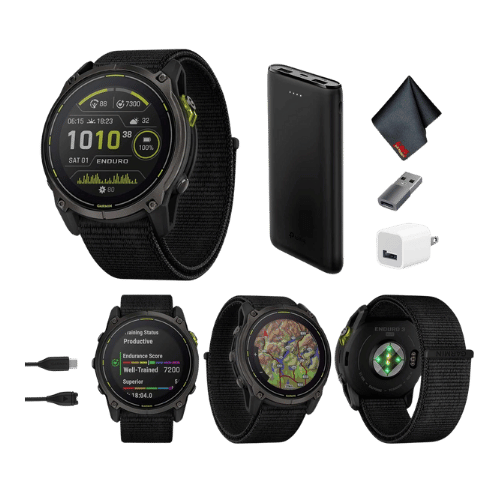
Garmin Enduro 3
iPhone, Android (Garmin Connect app required)
Garmin OS (Proprietary)
51mm x 51mm x 15.7mm
Fiber-reinforced polymer case with titanium rear cover; Titanium bezel; Power Sapphire solar charging lens
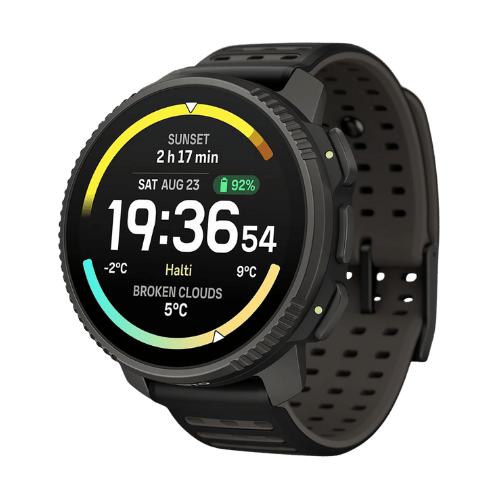
Suunto Vertical 2 Titanium
Android and iOS (Suunto App); Predefined replies (Android only)
Suunto Proprietary OS
49mm (49 x 49 x 13.6 mm)
Titanium Grade 5 bezel; Glass fibre reinforced polyamide case; Sapphire crystal glass
Only the specs that differ are shown here. Winners are highlighted when the data is clear.
+Full specs, pros, and cons
Everything side-by-side with ratings and the full spec list.
Expand
Full specs, pros, and cons
Everything side-by-side with ratings and the full spec list.
Comparison: Garmin Enduro 3 vs Suunto Vertical 2 Titanium
Garmin Enduro 3
Suunto Vertical 2 Titanium
| Criterion | Garmin Enduro 3 | Suunto Vertical 2 Titanium |
|---|---|---|
| Rating | ★5(7)Amazon | ★4.4(32)Amazon |
Compatibility | iPhone, Android (Garmin Connect app required) | Android and iOS (Suunto App); Predefined replies (Android only) |
Operating System | Garmin OS (Proprietary) | Suunto Proprietary OS |
Case Size | 51mm x 51mm x 15.7mm | 49mm (49 x 49 x 13.6 mm) |
Case Material | Fiber-reinforced polymer case with titanium rear cover; Titanium bezel; Power Sapphire solar charging lens | Titanium Grade 5 bezel; Glass fibre reinforced polyamide case; Sapphire crystal glass |
Display Type | Sunlight-visible, transflective memory-in-pixel (MIP) | LTPO AMOLED matrix display; Up to 2000 nits brightness; Always-On Display |
Display Size | 1.4 in (35.56 mm) diameter | 1.5 in |
Resolution | 280 x 280 pixels | 466 x 466 pixels |
Always On Display | Yes (MIP display is always visible) | Yes |
Water Resistance | 10 ATM (water pressure equivalent to 100 meters) | 100 m |
Durability | MIL-STD-810H (Thermal, Shock, Water); Scratch-resistant Sapphire lens | Tested to military standards (MIL-STD-810H); Titanium bezel; Sapphire crystal |
GPS | Multi-band GNSS with SatIQ technology; GPS, GLONASS, Galileo, QZSS, BeiDou | Dual-band GNSS (L1 + L5); GPS, GLONASS, GALILEO, QZSS, BEIDOU |
Connectivity | Bluetooth; ANT+; Wi-Fi | Bluetooth |
NFC Payments | Garmin Pay | — |
Sensors | Elevate Gen 5 optical heart rate sensor (ECG capable); Pulse Ox blood oxygen saturation monitor; Barometric altimeter; Compass; Gyroscope; Accelerometer; Thermometer | Optical heart rate (upgraded sensor); Pulse Ox (SpO2); Barometric altimeter (FusedAlti™); Digital compass; Thermometer; Accelerometer; Gyroscope |
Health Features | Garmin ECG App (region dependent); Body Battery; Sleep Score and advanced monitoring; HRV Status; Pulse Ox; Nap detection; Jet Lag Adviser; Health Snapshot | HRV recovery measurement; Sleep tracking (duration, quality, stages); Blood oxygen; Stress and recovery status; Fitness Level (VO2max) |
Workout Modes | Ultrarunning (with rest timer); Adventure Racing; Trail Run; Advanced Strength Training; Hiking; Cycling (MTB, Gravel, Road); Swimming (Pool & Open Water); Skiing; Surfing; and 100+ others | 115+ sport modes; Triathlon; Swimming (pool/open water); Running (power/pace); Cycling; Hiking; Ski touring; Snorkeling (depth up to 10m) |
Storage | 32GB | 32GB (Dedicated for offline maps) |
Speaker Mic | None (Audio prompts via connected Bluetooth headphones only) | — |
Calls | No (Can accept/decline calls to control phone; Android users can send text replies) | No (Call notifications only) |
Battery | Smartwatch mode: Up to 36 days (90 days with solar); GPS Only: Up to 120 hours (320 hours with solar); Expedition GPS: Unlimited with solar | Smartwatch: Up to 20 days; Performance Mode (Dual-band GPS + AOD): Up to 65 hours; Tour Mode: Up to 250 hours |
Charging | Garmin proprietary plug charger (USB-C cable included); Solar charging | Suunto magnetic fast charger (USB-C) |
Weight | 63 g (Case only: 57 g) — includes UltraFit nylon strap | 74 g |
Band Sizes | Fits wrists 127–225mm (UltraFit nylon strap included); QuickFit 26mm compatible | Fits wrists 125–175 mm (standard) or up to 215 mm; 22mm width |
Extras | Built-in LED Flashlight (Red/White strobes); Dynamic Round-Trip Routing; TopoActive Maps (preloaded); NextFork Map Guide; Grade Adjusted Pace; Real-time Stamina | Integrated LED Flashlight; Offline maps with heatmaps and surface info; Solar charging (Titanium Solar models only, though AMOLED limits efficacy); Climb Guidance; SuuntoPlus ecosystem |
| Pros |
|
|
| Cons |
|
|
As an Amazon Associate I earn from qualifying purchases. | Check Price on Amazon→ | Check Price on Amazon→ |
Garmin Enduro 3
iPhone, Android (Garmin Connect app required)
Garmin OS (Proprietary)
51mm x 51mm x 15.7mm
Fiber-reinforced polymer case with titanium rear cover; Titanium bezel; Power Sapphire solar charging lens
Sunlight-visible, transflective memory-in-pixel (MIP)
1.4 in (35.56 mm) diameter
Pros
- Unrivaled battery life: up to 90 days in smartwatch mode with solar
- Incredibly lightweight (63g) for a 51mm watch due to nylon strap/titanium
Cons
- Lacks the speaker/microphone found in the Fenix 8 series
- No diving certification (unlike Fenix 8 which is rated to 40m)
Suunto Vertical 2 Titanium
Android and iOS (Suunto App); Predefined replies (Android only)
Suunto Proprietary OS
49mm (49 x 49 x 13.6 mm)
Titanium Grade 5 bezel; Glass fibre reinforced polyamide case; Sapphire crystal glass
LTPO AMOLED matrix display; Up to 2000 nits brightness; Always-On Display
1.5 in
Pros
- Stunning 1.5-inch LTPO AMOLED display (2000 nits) is significantly brighter than the original MIP
- Integrated LED flashlight is a game-changer for camping and night safety
Cons
- No onboard music storage (only media controls)
- Lacks smart features like NFC payments and Bluetooth calling
Which one is better?
The Garmin Enduro 3 is the better buy for most people - its notable 90 days of battery life crushes the Suunto Vertical 2 Titanium. That said, grab the Suunto if you want a stunning display and don't mind charging more often.
Who should buy each?
Choose the Garmin Enduro 3 if: you need 90 days of battery life, enjoy extreme outdoor adventures, or prefer a lightweight design at 2.22 oz.
Choose the Suunto Vertical 2 Titanium if: you want a vibrant 1.5" AMOLED display, need integrated offline maps, or enjoy night camping with its built-in flashlight.
Quality Seekers
Higher user rating (5★ vs 4.4★) indicates better overall satisfaction
→ Choose Garmin Enduro
Safe Choice Buyers
More widely tested with 32 reviews vs 7
→ Choose Suunto Vertical
Unrivaled battery life: Priority
Unrivaled battery life: up to 90 days in smartwatch mode with solar
→ Choose Garmin Enduro
Stunning 1.5-inch LTPO Priority
Stunning 1.5-inch LTPO AMOLED display (2000 nits) is significantly brighter than the original MIP
→ Choose Suunto Vertical
Conclusion
There is no wrong answer here. Focus on the features you will use daily and pick the model that aligns with them.
Bottom line: The Garmin Enduro 3 edges ahead with a 5★ rating compared to 4.4★. However, Suunto Vertical 2 Titanium remains a strong contender if its strengths align better with your needs.
Frequently Asked Questions
+Which is better: Garmin Enduro 3 or Suunto Vertical 2 Titanium?
Garmin Enduro 3 is the better choice if you prioritize unrivaled battery life: up to 90 days in smartwatch mode with solar. Suunto Vertical 2 Titanium wins if you value stunning 1.5-inch ltpo amoled display (2000 nits) is significantly brighter than the original mip. Both are rated highly (5★ vs 4.4★), so consider your specific needs and budget.
+What are the main differences between Garmin Enduro 3 and Suunto Vertical 2 Titanium?
Key differences: Garmin Enduro 3 offers unrivaled battery life: up to 90 days in smartwatch mode with solar, while Suunto Vertical 2 Titanium stands out with stunning 1.5-inch ltpo amoled display (2000 nits) is significantly brighter than the original mip. Consider that Garmin Enduro 3 lacks the speaker/microphone found in the fenix 8 series. Meanwhile, Suunto Vertical 2 Titanium no onboard music storage (only media controls). Check the detailed specs table above for a complete comparison.
+What should I prioritize when choosing between these smartwatches?
Focus on the features that matter most for your daily use. Garmin Enduro 3 stands out for unrivaled battery life: up to 90 days in smartwatch mode with solar and incredibly lightweight (63g) for a 51mm watch due to nylon strap/titanium. Suunto Vertical 2 Titanium excels at stunning 1.5-inch ltpo amoled display (2000 nits) is significantly brighter than the original mip and integrated led flashlight is a game-changer for camping and night safety. Check the spec table above for the complete side-by-side breakdown.
Affiliate disclosure
PageBen uses Amazon affiliate links. If you purchase through our links, we may earn a commission at no extra cost to you. This supports independent content for US shoppers.