
Apple iPhone 17 Pro Max vs Motorola razr (2023)
In real-world use, that battery lasts up to 39 hours of video playback, making it perfect for heavy users who need reliability on the go. While it’s lighter at 6.65oz, it lacks the premium feel and capabilities of the iPhone, but if you’re looking for a budget-friendly foldable, it’s worth considering. Key specs: Refresh: 120 Hz vs 144 Hz and Battery: 5088 mAh vs 4200 mAh.
Why compare these? The Apple iPhone 17 Pro Max (premium flagship) and Motorola razr (2023) (mid-range) represent different approaches to smartphones. While they may appeal to different budgets, many buyers consider both options. This 2026 comparison helps you decide if the differences justify the price gap.
As an Amazon Associate I earn from qualifying purchases.
Key Differences at a Glance
| Aspect | Apple iPhone | Motorola razr |
|---|---|---|
| User Rating | ✓4.8★ (126 reviews) | 4.3★ (513 reviews) |
| Top Strength | Brightest iPhone display ever (3000 nits peak outdoor) | Most accessible price point for a new foldable phone in the US |
| Main Drawback | Large and heavy form factor (233 g) | External display (1.5") is tiny and only useful for basic notifications (unlike Razr+) |
| Market Position | ✓Flagship | Mid-range |
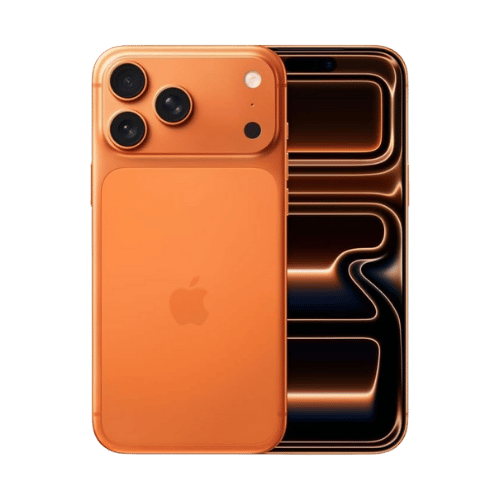
Apple iPhone 17 Pro Max
iOS
Minimum 5 years from release date (guaranteed security updates); historically supports 6+ years of OS upgrades
Apple A19 Pro chip (3nm; 6-core CPU: 2 performance + 4 efficiency; 16-core Neural Engine; hardware-accelerated ray tracing)
Apple 6-core GPU with Neural Accelerators (A19 Pro)
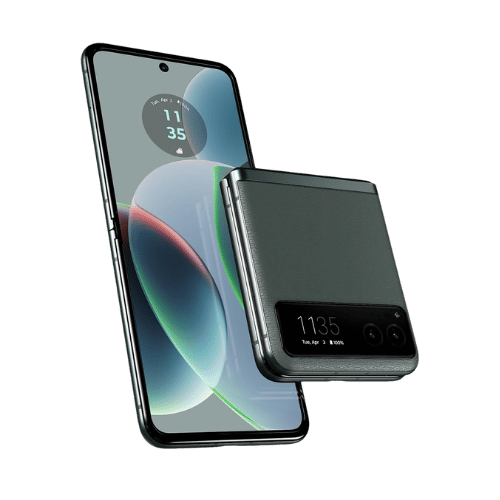
Motorola razr (2023)
Android
3 Android OS upgrades and 4 years of bi-monthly security updates
Qualcomm Snapdragon 7 Gen 1 (4nm)
Adreno 644
Only the specs that differ are shown here. Winners are highlighted when the data is clear.
+Full specs, pros, and cons
Everything side-by-side with ratings and the full spec list.
Expand
Full specs, pros, and cons
Everything side-by-side with ratings and the full spec list.
Comparison: Apple iPhone 17 Pro Max vs Motorola razr (2023)
Apple iPhone 17 Pro Max
Motorola razr (2023)
| Criterion | Apple iPhone 17 Pro Max | Motorola razr (2023) |
|---|---|---|
| Rating | ★4.8(126)Best Buy | ★4.3(513)Best Buy |
Operating System | iOS | Android |
Software Support | Minimum 5 years from release date (guaranteed security updates); historically supports 6+ years of OS upgrades | 3 Android OS upgrades and 4 years of bi-monthly security updates |
Processor | Apple A19 Pro chip (3nm; 6-core CPU: 2 performance + 4 efficiency; 16-core Neural Engine; hardware-accelerated ray tracing) | Qualcomm Snapdragon 7 Gen 1 (4nm) |
Graphics | Apple 6-core GPU with Neural Accelerators (A19 Pro) | Adreno 644 |
RAM | 12 GB (LPDDR5X) | 8GB LPDDR4X |
Storage | 256GB / 512GB / 1TB / 2TB (NVMe) | 128GB UFS 2.2 (Non-expandable) |
Display Size | 6.9" (6.86" measured diagonally as a standard rectangle; actual viewable area is less) | Main: 6.9" / External: 1.5" |
Screen Type | Super Retina XDR OLED | Main: FHD+ pOLED, LTPO, 144Hz / External: OLED, 60Hz |
Resolution | 2868 x 1320 pixels (460 ppi) | Main: 2640 x 1080 (413 ppi) / External: 194 x 368 (282 ppi) |
Refresh Rate | Up to 120 Hz (ProMotion adaptive 1-120Hz) | Main: Up to 144Hz / External: 60Hz |
Peak Brightness | 1000 nits max (typical); 1600 nits peak (HDR); 3000 nits peak (outdoor); 1 nit minimum | 1,400 nits (Main Peak) / 1,000 nits (External Peak) |
Main Camera | 48MP Fusion Main (24 mm, f/1.78), 2nd-gen sensor-shift optical image stabilization, 100% Focus Pixels, support for 24MP and 48MP super-high-resolution photos | 64MP, f/1.7, 0.7µm, OIS, Laser AF (Quad Pixel to 16MP) |
Ultra-Wide Camera | 48MP Fusion Ultra Wide (13 mm, f/2.2, 120° field of view), Hybrid Focus Pixels, 48MP macro photography | 13MP, f/2.2, 120-degree FOV, Macro Vision |
Telephoto Camera | 48MP Fusion Telephoto (100 mm, f/2.8), tetraprism design, 3D sensor-shift OIS, autofocus; enables 12MP optical-quality 8x zoom (200 mm equivalent) | No (Not supported) |
Optical Zoom | 0.5x, 1x, 2x, 4x, 8x optical-quality zoom steps (16x optical zoom range) | No (Not supported) |
Digital Zoom | Up to 40x | Up to 8x |
Video Recording | 4K Dolby Vision at 24/25/30/60/100/120 fps (Fusion Main); ProRes up to 4K at 120 fps with external recording; Cinematic mode up to 4K HDR at 30 fps | 4K UHD @ 30fps; 1080p @ 30/60fps |
Front Camera | 18MP Center Stage (f/1.9), autofocus with Focus Pixels, 4K Dolby Vision at 24/25/30/60 fps | 32MP, f/2.4, 0.7µm (Quad Pixel to 8MP) |
Battery | 5088 mAh (Li-ion, eSIM model); Up to 39 hours video playback (35 hours streamed) | 4,200mAh (Non-removable) |
Wired Charging | USB-C; Up to 50% charge in ~20 minutes with 40W adapter or higher | 30W TurboPower (Charger NOT included in US retail box) |
Wireless Charging | MagSafe up to 25W (with 30W+ adapter); Qi2 up to 25W; Qi up to 7.5W | 5W Wireless Charging |
Connectivity | 5G (sub-6 GHz and mmWave) with 4x4 MIMO; Gigabit LTE; Wi-Fi 7 (802.11be) with 2x2 MIMO; Bluetooth 6.0; Ultra Wideband (Second-generation); Thread networking technology; NFC with reader mode | 5G (Sub-6/mmWave - Carrier Dependent), Wi-Fi 6E, Bluetooth 5.3, NFC |
USB | USB-C connector with USB 3 speeds (up to 10 Gb/s); Native DisplayPort output | USB Type-C 2.0 |
Durability | IP68 (maximum depth of 6 meters up to 30 minutes); Ceramic Shield 2 front; Ceramic Shield back; Aerospace-grade aluminum unibody (with internal vapor chamber) | IP52 (Water-repellent coating - Splash Resistant only) |
Dimensions | 6.43" x 3.07" x 0.34" (163.4 x 78.0 x 8.75 mm) | Open: 6.73 x 2.91 x 0.29 in (170.8 x 74.0 x 7.35 mm) / Closed: 3.47 x 2.91 x 0.62 in |
Weight | 8.22 oz (233 g) | 6.65 oz (188.6 g) |
Biometrics | Face ID | Side-mounted fingerprint reader, Face Unlock |
Extras | Apple Intelligence support; Camera Control button; Action button; Dynamic Island; Always-On display; Dual eSIM (US models); Emergency SOS via satellite; Crash Detection; Roadside Assistance via satellite | Vegan Leather finish, Stereo Speakers (Dolby Atmos), Ready For (Wireless only) |
| Pros |
|
|
| Cons |
|
|
As an Amazon Associate I earn from qualifying purchases. | Check Price on Amazon→ | Check Price on Amazon→ |
Apple iPhone 17 Pro Max
iOS
Minimum 5 years from release date (guaranteed security updates); historically supports 6+ years of OS upgrades
Apple A19 Pro chip (3nm; 6-core CPU: 2 performance + 4 efficiency; 16-core Neural Engine; hardware-accelerated ray tracing)
Apple 6-core GPU with Neural Accelerators (A19 Pro)
12 GB (LPDDR5X)
256GB / 512GB / 1TB / 2TB (NVMe)
Pros
- Brightest iPhone display ever (3000 nits peak outdoor)
- Triple 48MP camera system with 8x optical-quality zoom
Cons
- Large and heavy form factor (233 g)
- Fastest charging speeds require purchasing a 40W+ adapter separately
Motorola razr (2023)
Android
3 Android OS upgrades and 4 years of bi-monthly security updates
Qualcomm Snapdragon 7 Gen 1 (4nm)
Adreno 644
8GB LPDDR4X
128GB UFS 2.2 (Non-expandable)
Pros
- Most accessible price point for a new foldable phone in the US
- Battery life (4,200mAh) exceeds that of the premium Razr+ and Galaxy Z Flip5
Cons
- External display (1.5") is tiny and only useful for basic notifications (unlike Razr+)
- Charger is NOT included in the box (unlike previous Moto G phones)
Which one is better?
Battery life: Apple iPhone 17 Pro Max is rated for up to 39 hours.
Who should buy each?
Choose the Apple iPhone 17 Pro Max if: you need a powerful camera for photography, you watch video for hours daily, or you want the best performance for gaming. (120 Hz refresh, 5088 mAh battery)
Choose the Motorola razr (2023) if: you prefer a foldable design, you want a lighter phone, or you're looking for an accessible price point. (144 Hz refresh, 4200 mAh battery)
Quality Seekers
Higher user rating (4.8★ vs 4.3★) indicates better overall satisfaction
→ Choose Apple iPhone
Safe Choice Buyers
More widely tested with 513 reviews vs 126
→ Choose Motorola razr
Premium Buyers
Higher-tier option with more premium features and build quality
→ Choose Apple iPhone
Value Seekers
Better value proposition for buyers who don't need top-tier features
→ Choose Motorola razr
Conclusion
There is no wrong answer here. Focus on the features you will use daily and pick the model that aligns with them.
Bottom line: The Apple iPhone 17 Pro Max edges ahead with a 4.8★ rating compared to 4.3★. However, Motorola razr (2023) remains a strong contender if its strengths align better with your needs.
Frequently Asked Questions
+Which is better: Apple iPhone 17 Pro Max or Motorola razr (2023)?
Apple iPhone 17 Pro Max is the better choice if you prioritize brightest iphone display ever (3000 nits peak outdoor). Motorola razr (2023) wins if you value most accessible price point for a new foldable phone in the us. Both are rated highly (4.8★ vs 4.3★), so consider your specific needs and budget.
+What are the main differences between Apple iPhone 17 Pro Max and Motorola razr (2023)?
Key differences: Apple iPhone 17 Pro Max offers brightest iphone display ever (3000 nits peak outdoor), while Motorola razr (2023) stands out with most accessible price point for a new foldable phone in the us. Consider that Apple iPhone 17 Pro Max large and heavy form factor (233 g). Meanwhile, Motorola razr (2023) external display (1.5") is tiny and only useful for basic notifications (unlike razr+). Check the detailed specs table above for a complete comparison.
+What should I prioritize when choosing between these smartphones?
Focus on the features that matter most for your daily use. Apple iPhone 17 Pro Max stands out for brightest iphone display ever (3000 nits peak outdoor) and triple 48mp camera system with 8x optical-quality zoom. Motorola razr (2023) excels at most accessible price point for a new foldable phone in the us and battery life (4,200mah) exceeds that of the premium razr+ and galaxy z flip5. Check the spec table above for the complete side-by-side breakdown.
Affiliate disclosure
PageBen uses Amazon affiliate links. If you purchase through our links, we may earn a commission at no extra cost to you. This supports independent content for US shoppers.